Most founders remember the first domain they bought. Sure, it might have felt small at the time. A quick search, a click, and a quiet hope for what might come next.
But as the internet exploded, your domain name began to carry weight, shaping your site’s direction and hinting at what could be built.
Safe to say, today, domain works like a stake in the modern market. It can:
- grow in value while you go about your day
- open doors before a product exists
- steady a brand before a team forms around it
Put simply, founders treat domains more seriously now. They watch shifts in culture, notice new patterns, and sense when an idea is about to matter. This is probably why 368.4 million total domain registrations occurred in Q1 2025.
A strong name works like early capital because it influences how a business enters the world and how quickly it finds its footing. And if you’ve ever held onto a name because you knew its moment would arrive, you already understand this space. More importantly, if you’ve ever lost a name because you waited too long, you understand it even better.
This guide looks at domains as assets that gain value as markets change and as buyers seek clarity amid the noise. Let’s get into it!
Strategic Ownership: How Founders Build Long-Term Equity Through Domains
Who is this for: SME founders planning multi-year brand growth, marketing leads focused on digital identity, and entrepreneurs looking to protect future business value.
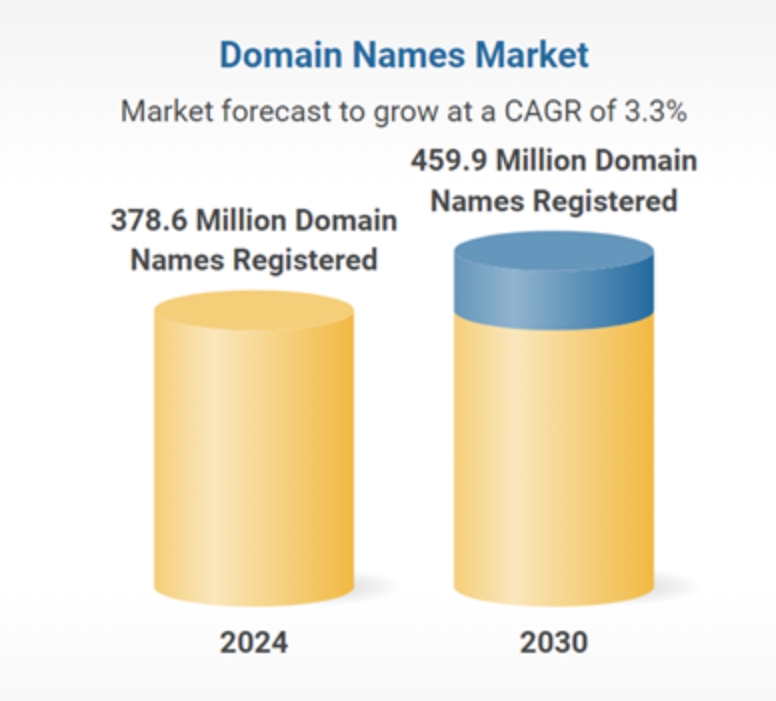
You can expect domain demand to keep growing: the global domain market is projected to hit 459.9 million registrations by 2030, growing at roughly 3.3% annually. This steady growth creates a strong tailwind for domain equity and long-term digital asset value:
Many SME founders reach a stage where customer acquisition feels harder than it should be. Search traffic plateaus. Competitors enter the space with sharper messaging. Brand recall weakens.
A well-chosen domain often stabilises these issues because your name influences how customers interpret your offer before they ever reach your homepage.
Domain investing pushes you to look at naming through a business lens. You develop an eye for terms that carry momentum in your industry. You identify names that align with how customers articulate their needs. You also start recognising when a domain signals authority strongly enough to influence early trust.
Key considerations for strategic domain ownership:
- Map your current and future products to potential domain expansions.
- Monitor industry language shifts and adapt naming accordingly.
- Protect domains in adjacent markets to prevent competitor capture.
- Evaluate your domains periodically for relevance and future utility.
Questions to ask yourself:
- Does this domain strengthen your long-term brand story?
- Will it support multiple product lines or market extensions?
- Is the domain defensible against competitor acquisition?
- Does it create a measurable advantage during investor or partner evaluation?
Pro Tips:
- Archive all naming patterns from past launches to identify recurring trends.
- Use customer communications to inform naming rather than relying on internal brainstorming.
- Keep a lean but high-quality domain portfolio to focus on impact rather than volume.
- Conduct quarterly audits of your domain assets to ensure alignment with growth plans.
- Document the domain rationale for each acquisition, so strategic decisions remain clear.
Early-Stage Flipping: Reading Buyer Intent and Timing the Market
Who is this for: Beginner investors, freelancers exploring digital asset income, or founders testing high-value names for resale.
New investors often face a specific hurdle: They buy names that look clever on paper but don’t align with how businesses brand themselves.
Domain flipping works when the name feels ready for commercial use. You want a term that a founder can plug into a pitch deck without second-guessing. You also want flexibility so the domain can support different growth paths for the buyer.
Beginners who stay focused on business-ready names gain traction much faster. They understand that buyers want clarity more than creativity.
Actionable strategies:
- Track patterns in recent sales to understand what buyers pay a premium for.
- Validate names by asking real users if they communicate immediate business relevance.
- Avoid names that rely on cleverness or novelty; focus on clarity.
- Maintain flexibility so domains can suit multiple verticals.
Questions to evaluate each name:
- Will a founder recognise its value without explanation?
- Can the domain function across more than one business model?
- Does it retain authority when spoken aloud?
- Are similar names consistently selling in your target markets?
Pro Tips for early-stage investors:
- Start with a few high-potential names before scaling your portfolio.
- Monitor buyer inquiries in marketplaces to anticipate demand shifts.
- Observe naming trends in venture announcements for emerging patterns.
- Consider seasonal spikes in category interest for timing flips.
- Test names with small focus groups to refine commercial clarity.
Pro Tip: You can invest in the ever-expanding .ai extension, which is now mainstream in the domain aftermarket. Over 533,000 .ai names were registered by late 2024, and the ccTLD’s resale volume more than doubled in 2024 compared with the year before. This means flipping .ai domains has real upside, but only if you pick names high in both meaning and liquidity.
Evaluation Science: How to Judge the True Market Value of a Name
Who should focus on valuation: SMEs planning brand expansion, investors evaluating resale potential, and marketing teams preparing new naming frameworks.
Valuing a domain becomes easier when you break it down into practical components.
You need a name that supports long-term commercial use. You also need a term that customers understand the moment they hear it.
Value grows when a domain aligns with broad demand across multiple business models.
Strong domain evaluation relies on simple, measurable signals. You look at keyword strength, search relevance, and the likelihood that a founder will choose that exact phrasing when introducing a new offer.
When you evaluate a domain, it’s not enough to guess. In Q3 2025, domains reached 378.5 million total registrations, up 1.8% from the prior quarter. This growth underlines how buyer demand is accelerating. Choosing the right name now means positioning yourself ahead of a rising tide.
Steps to evaluate domain value:
- Break the name into measurable criteria: clarity, versatility, and scalability.
- Research search patterns and buyer intent behind the root terms.
- Identify which industries or verticals could adopt the name.
- Compare the name’s performance with competitors’ successful launches.
Questions to validate value:
- Does the domain align with common customer search behaviours?
- Will the name retain relevance five years from now?
- Can it support product and brand expansion?
- Does it simplify customer acquisition and improve trust?
Pro Tips:
- Track category keywords that consistently drive engagement.
- Avoid overly niche or trendy phrases that limit scalability.
- Prioritise names suitable for both typed and voice searches.
- Assess how each name reduces friction in customer acquisition.
- Use seasonal or market shifts to test the domain’s adaptability.
Asset Architecture: Structuring a Domain Portfolio That Supports SME Expansion
Ideal audience profile: SME owners expanding their online footprint, teams formalising brand architecture, and founders building a stronger identity.
A structured portfolio transforms domains into operational assets. It ensures each name contributes to broader business strategy, reducing inefficiency and confusion across campaigns.
The domain ecosystem is expanding beyond just .com: by mid‑2025, 1,440 TLDs had been delegated, including 151 internationalised TLDs (IDNs). This opens up naming flexibility (think regional domains, non-Latin scripts, and more nuanced brand strategies).
Implementation steps:
- Audit all current domains to identify gaps or redundancies.
- Align naming styles across product pages and marketing materials.
- Reserve supporting domains to protect brand extensions.
- Document the role of each domain in operational and marketing workflows.
Evaluation questions:
- Does the domain anchor your digital ecosystem effectively?
- Will it remain coherent as the company expands?
- Does it simplify collaboration with partners and internal teams?
- Can the portfolio evolve without causing brand friction?
Pro Tips:
- Maintain a hierarchy between primary and supporting domains.
- Revisit your naming strategy before launching new products.
- Ensure messaging consistency across channels.
- Use your domain portfolio to streamline campaign planning.
- Track cross-channel alignment for all digital properties.
Domain as Asset KPI Table:
| Metric | Business Impact | Asset Value Implication |
| Clarity | Faster user trust | Higher liquidity |
| Versatility | Supports multiple products | Broader ROI potential |
| Memorability | Better retention | Long-term valuation growth |
| Market Fit | High demand | Easier resale & appreciation |
Category Leadership: Choosing Names That Win Competitive Markets
Who is this for: SMEs entering competitive sectors, founders preparing for market expansion, marketing teams building authority-led brands.
Premium domains such as .com act as a signal of authority. They accelerate credibility, shorten trust-building cycles, and position your brand as a leader in its category.
Legacy TLDs like .com/.net remain dominant: by Q3 2025, their combined registration base hit 171.9 million domains. It’s a reminder that premium .com names still carry unmatched trust and liquidity.
Strategic steps for choosing high-impact domains:
- Benchmark competitor names to define clarity and tone standards.
- Test candidate domains across multiple product lines and messaging contexts.
- Evaluate market perception via small-scale messaging experiments.
- Prioritise names that naturally convey authority to customers and partners.
Critical questions:
- Does this domain immediately elevate your market position?
- Would customers perceive the brand as more trustworthy under this name?
- Does it align with your long-term growth vision?
- Can it be leveraged in investor or partner negotiations?
Pro Tips:
- Invest in premium names only when they complement long-term branding goals.
- Ensure the domain works seamlessly across all marketing channels.
- Use authority testing with target users before final acquisition.
- Align the name with immediate campaigns and future growth simultaneously.
- Track domain influence on early-stage traction and sales metrics.
Bookmark This: A Practical Domain Evaluation Matrix for SMEs
SME founders often juggle strategy, product launches, and customer acquisition.
A structured approach to domain evaluation saves time, reduces errors, and helps you identify names that truly add valueto your business:
Domain Evaluation Matrix for SMEs
| Evaluation Factor | Target Audience | Core Actions | Assessment Checklist | Advanced Tips |
| Strategic Domain Selection | Founders planning multi-year growth and cohesive branding | Map domains to 2–3 year growth plans Identify terms already in customer conversations Rank names by long-term adaptability | Will the domain scale with new products? Does it clearly signal the business category? Is it easy for target customers to understand? | Archive all potential names and revisit quarterly Track competitor shifts in naming trends Prioritise simplicity over cleverness |
| Domain Flipping for Beginners | Early-stage investors, freelancers exploring digital assets | Compare past niche sales for patterns Validate clarity with people outside your sector Eliminate overly clever or personal names | Would a founder immediately see commercial use? Can it serve multiple industries? Does it maintain meaning when spoken aloud? | Keep a focused portfolio of high-potential names Track inbound buyer interest Observe seasonal trends for niche demand |
| Domain Value Assessment | Investors, SMEs rebranding, marketing teams | Break domains into measurable traits: memorability, clarity, versatility Examine keyword strength and search intent Identify industries that could adopt the name | Does it match real customer search behaviour? Will it stay relevant in 5+ years? Can it reduce friction in customer acquisition? | Focus on names that work in both voice and typed search Avoid overly narrow or fad-based terms Check alignment with brand tone and positioning |
| Online Asset Structuring | SMEs consolidating digital presence, founders managing multiple URLs | Audit current domains for gaps Align naming across product lines Reserve supporting domains for new initiatives | Does it reinforce your market positioning? Will it make sense as the company grows? Does it simplify marketing and communications? | Keep a clean hierarchy of primary vs. supporting domains Revisit naming strategy before product expansions Align messaging consistently across channels |
| Premium Domain Investment | Growing SMEs, founders in crowded markets, marketing teams boosting authority | Validate the domain against competitor benchmarks Test clarity and trust with target audience Ensure scalability for future products | Will it enhance market positioning? Does it convey authority instantly? Can it remain relevant across multiple campaigns? | Evaluate suitability across all marketing channels Align with long-term brand architecture Measure impact on early buyer perception |
Bonus: Sharpen Your Domain Decision-Making
Founders who approach domains strategically gain a clearer perspective on which names actively advance their business and which may become obstacles.
By understanding the real impact of a domain, you can align early choices with long-term growth, market positioning, and brand authority.
Insights You’ll Gain as Your Approach Evolves
- Real-world customer language guides naming decisions more effectively than internal brainstorming sessions.
- Emerging trends reveal which sectors are ripe for growth, helping you identify domains with future demand.
- Product expansions become more seamless when the domain naturally accommodates new offerings.
- Investor and partner communications are strengthened when your domain instantly conveys credibility and purpose.
Immediate Advantages for SMEs
- Reduces hesitation from potential customers, making first impressions count.
- Supports sales efforts by reinforcing brand authority and professionalism.
- Accelerates marketing campaigns since naming aligns with audience expectations and search behaviour.
- Simplifies strategic planning as expansion initiatives integrate smoothly with your existing domain portfolio.
Give Your Domain a Bigger Purpose with BigRock
Once you see domains as digital real estate, you start to understand how much potential sits in a single name. It guides how people find you, how your brand grows, and how much equity you build as the market shifts. That is the real economics of online ownership. Every domain you choose can either move your business forward or hold it back.
BigRock helps you make those choices with clarity. You get strong performance, simple management, and the structure you need to turn a domain into a long term asset.
Whether you are securing a high potential name or strengthening the one you already have, BigRock gives you the stability and room to grow.
With BigRock, you can shape a digital presence that gets stronger as your business expands. So why wait? Speak to our team now!
FAQs
How do you know if a domain can appreciate in value over time?
Start by checking how many businesses or creators would realistically want the same name. Look at search interest, rising terminology in your industry, and how easy the domain is to remember and type. If the name feels clear, broad enough for multiple uses, and tied to a growing market, you are already looking at a potential appreciating asset.
What is the difference between buying a domain for your business and buying one as an investment?
When you buy for your business, you focus on brand fit and long term use. When you buy as an investment, you evaluate how the wider market might value the same name in the future. Both approaches overlap, but investors study demand patterns while owners focus on identity and trust. Understanding both lenses helps you make stronger decisions.
Can a beginner start domain investing without building a large portfolio?
Yes. You can start with one or two strong names that show clear business potential. A focused approach helps you learn how value grows, how markets shift, and how buyers behave. Many profitable investors began with a single domain they believed in and expanded only after they understood the market’s rhythm.
What should you look for before buying a domain for resale?
Look for clarity, brevity, strong keywords, and names that address a real business need. Avoid names tied to trademarks or hype cycles.
Check comparable sales and see if the name makes sense in multiple industries. If the domain feels useful today and even more useful as the market evolves, it is worth considering.
How do domain extensions affect value in the long run?
Extensions influence trust and positioning. A .com usually carries the highest demand because people remember it easily, but strong names on newer extensions can still gain value if they match clear intent. Focus on whether your domain extension supports the idea behind the name. Buyers pay for clarity, not trends.