
Reseller hosting sounds simple until your first client calls you about a website that isn’t loading.
This becomes your eureka moment: You realise you are no longer just selling space on a server; you are responsible for uptime, email delivery, performance, and support.
Your hosting provider stops being a backend detail and starts becoming part of your reputation.
If you are planning to launch a web business in India, this choice matters more than most people admit.
You might be a designer offering hosting to clients, a developer bundling sites with maintenance, or an entrepreneur building a small hosting brand. Either way, your customers will not care which data center you picked or how cheap your plan was. They care that their site stays online, their emails arrive, and you stay in control when the site stops working.
In this guide, we’ll walk through:
- factors that matter when choosing reseller hosting in India,
- how to avoid common hosting traps
- how to pick a hosting platform that supports your business
If your goal is to build something reliable, profitable, and professional, you’re at the right place. Let’s go!
But First, What is Reseller Hosting?
If you run a web agency, build client websites, or manage digital projects, you’ve likely faced this problem: clients expect hosting, but managing servers pulls you away from billable work.
Reseller hosting solves this.
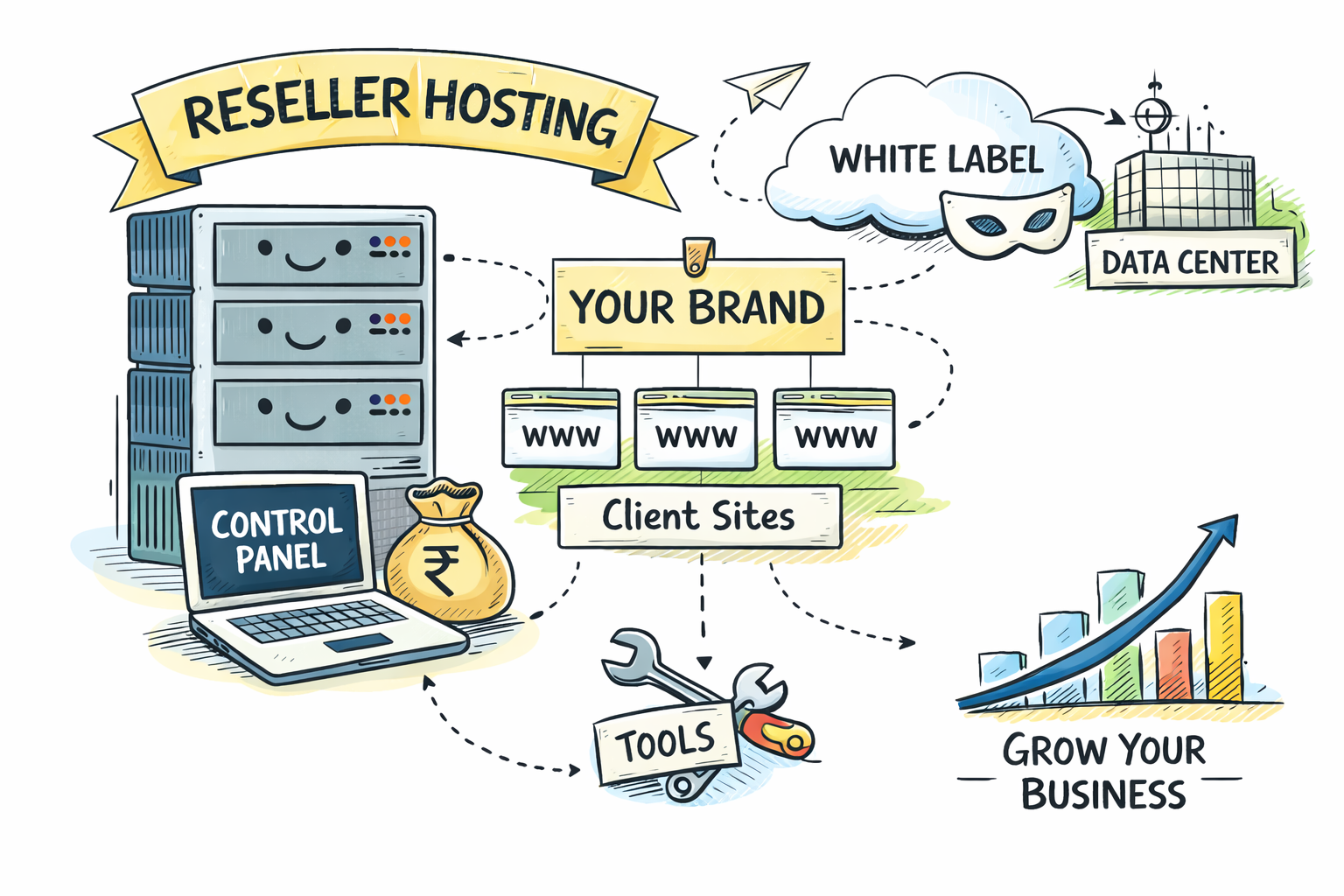
You buy hosting resources from an infrastructure provider and sell them to your clients under your own brand. You control pricing, packages, billing, and account access. Your customers deal with you directly (and not the company running the servers).
You operate your own hosting business without owning hardware.
How It Works
After signing up, you receive access to server capacity, a management dashboard, and tools to create individual hosting accounts.
You decide:
- How much storage each client gets
- Bandwidth limits
- Email accounts
- Resource allocation per website
Every account carries your company name. Invoices come from you. Support requests land in your inbox.
Your clients experience a complete hosting service.
Behind the scenes, your provider handles:
- Data centers
- Server maintenance
- Security updates
- Infrastructure stability
You stay focused on customers and revenue.
5 Reasons Why Reseller Hosting Is a Smart Move for Your Business
The global web hosting market continues to expand rapidly as more companies move online and invest in digital infrastructure.
In 2025, the web hosting services market was valued at over $137.73 billion and is expected to grow strongly through the rest of the decade, reaching nearly $389.52 billion by 2034.
In India, the web hosting services market was worth roughly $11 billion in 2024 and is projected to more than triple by 2033 as small and medium businesses increasingly adopt cloud-based tools and online services:

Growth is driven by digital transformation, cloud adoption, and the need for scalable hosting solutions.
For agencies and SME owners, reseller hosting lets you expand your revenue streams while focusing on what you do best: finding and serving customers.
Reason #1: Better Quality Control
When you sell hosting under your own brand, you make the rules.
You decide performance standards and the support experience your clients receive.
You don’t hand them off to a third-party provider where you have no control over uptime or responsiveness.
In a market where reliable infrastructure is increasingly important, owning customer perception is everything.
Verdict: Global estimates suggest the hosting industry could nearly triple in size over the next decade, meaning demand for dependable hosting and dependable partners will continue to rise.
Reason #2: Stronger Brand Presence
Clients see your name on every invoice, control panel, support ticket, and billing statement. You become the face of their hosting experience.
This matters because digital services are more competitive now than ever, and trust plays a major role in retention and referrals.
Reason #3: Predictable Monthly Revenue
Reseller hosting turns one-time projects into ongoing income. Instead of just building a site for a client and moving on, you can bundle hosting in monthly plans that provide steady recurring revenue.
As mentioned earlier, the global web hosting market demonstrates a strong compound annual growth trend. Obviously, this means more businesses are expected to pay for hosting services regularly, providing a more reliable foundation for your cash flow.
Reason #4: A Professional Service Offering
Clients today want performance guarantees, uptime commitments, and a single source of responsibility when issues crop up on their site.
When your hosting is part of your service stack, your business looks completer and more capable. You reduce friction for clients who would otherwise have to manage their own hosting or go through a third party.
Reason #5: Less Technical Overhead for You
One of the biggest hidden costs for any small IT business is managing infrastructure. With reseller hosting, your provider handles:
- Server maintenance
- Security patches
- Network uptime
- Scaling during peak traffic
You stay focused on customer acquisition, account management, and service delivery as opposed to server rooms and infrastructure stacks.
5 Challenges of Reseller Hosting You Might Be Struggling With
Most reseller businesses don’t fail because of pricing or even features for that matter. They struggle because operational cracks appear once real clients come onboard.
Support queues might start to grow. Performance might become unpredictable. Accountability, in most cases, begins to blur.
But know that these problems rarely surface on day one. They emerge when you start scaling, onboarding multiple customers, and handling production workloads.
If you run a small agency or hosting brand, chances are you have already felt at least one of these.
Here’s a clear look at the most common friction points:
| Pressure Point | Who Usually Feels It First | Early Warning Signals |
| 1. Unpredictable Server Performance | Agencies managing multiple client sites on shared reseller infrastructure | Websites slow down during peak hours, inconsistent page load times, random spikes in resource usage, clients reporting lag without clear root causes |
| 2. Support Dependency on Upstream Providers | Solo resellers and small teams without internal technical staff | Long wait times for tickets, generic responses, delayed fixes, you acting as a middleman instead of problem solver |
| 3. Limited Account Isolation Between Clients | Designers and developers hosting many unrelated businesses on one reseller plan | One compromised site impacts others, malware spreads across accounts, frequent cleanup requests, growing security anxiety |
| 4. Operational Overhead That Scales Faster Than Revenue | Growing agencies onboarding 10+ hosting clients | Manual account creation, billing inconsistencies, chasing renewals, support requests eating into delivery time |
| 5. Brand Risk Without Infrastructure Control | White label hosting resellers building client-facing brands | Clients blaming you for outages, difficulty explaining downtime, erosion of trust when backend failures occur |
Key Takeaways for Reseller Businesses
- Retention: Performance instability directly impacts client retention. Slow sites and intermittent downtime lead to cancellations, refunds, and harder renewals.
- Exposure: Poor account isolation increases your exposure to security incidents originating outside your control. One compromised website can affect multiple clients, forcing you into cleanup and damage control.
- Dependency: Dependence on upstream support slows resolution times. You lose ownership of response speed while still carrying full responsibility in front of customers.
- Inefficiency: Manual operations scale faster than revenue. Account setup, billing follow-ups, and support requests consume hours that should go toward client acquisition or delivery.
- Reputation: Brand risk accumulates quietly. A single outage or prolonged incident can undo months of trust-building and trigger difficult conversations with long-term clients.
- Drift: Over time, these pressures shift your role from operator to incident manager. Instead of building partnerships or expanding services, you spend your day relaying updates and coordinating fixes you cannot directly implement.
- Discipline: Mature resellers prioritize operational resilience over feature lists. They evaluate platforms based on predictable performance, responsive support, strong account isolation, and practical management tooling.
- Outcome: These fundamentals determine whether reseller hosting supports sustainable growth or becomes a recurring source of friction across sales, support, and delivery.
What to Look for in a Reseller Hosting Platform?
On paper, every provider promises speed, uptime, and unlimited features.
In reality, affordable reseller hosting often comes with hidden trade-offs: overcrowded servers, slow support, poor isolation, and dashboards that make simple tasks harder than they should be.
And once you add white label hosting into the mix, the pressure skyrockets.
Use this framework to evaluate a reseller hosting provider before you commit.
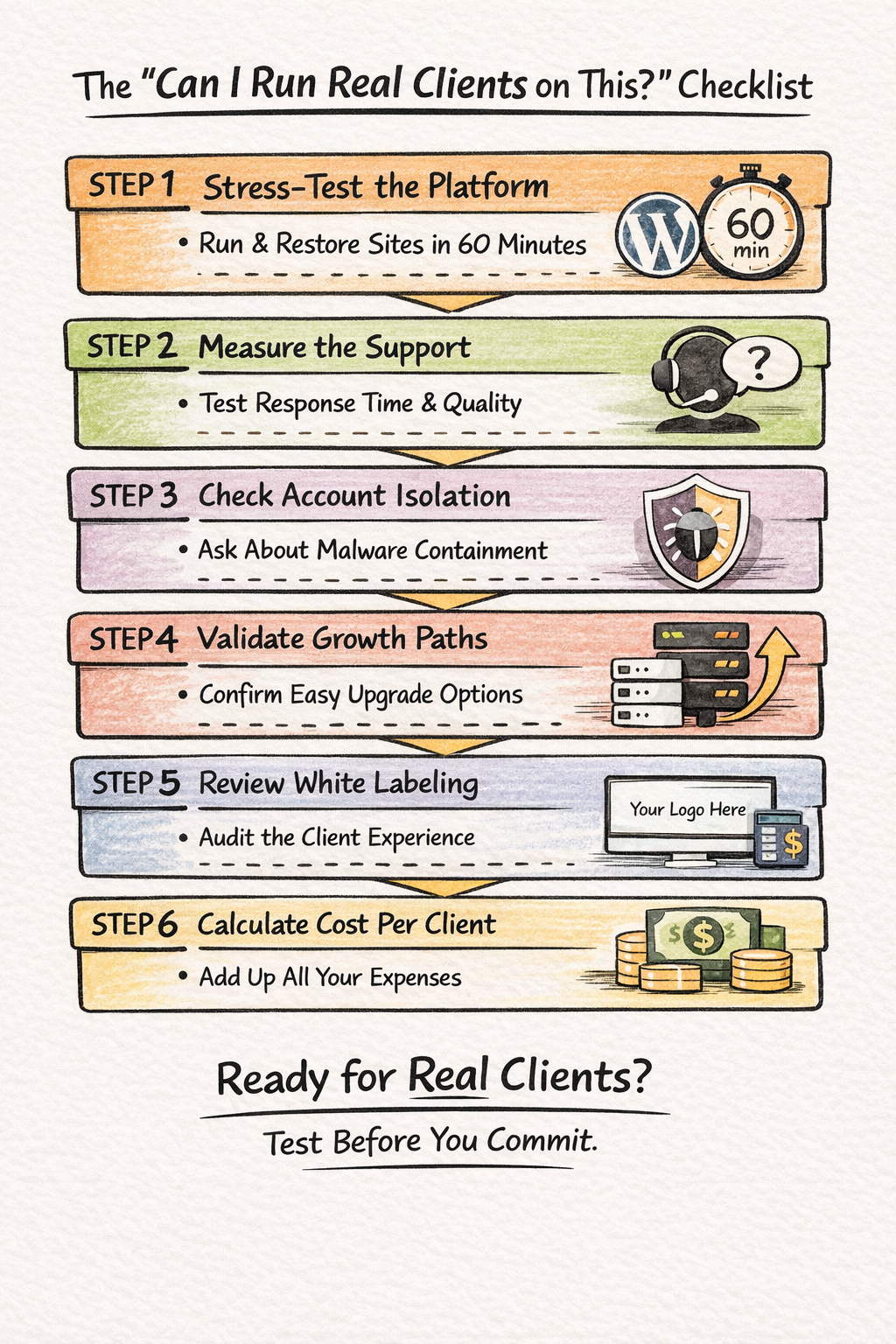
The “Can I Run Real Clients on This?” Checklist
Step 1: Stress-Test the Platform in 60 Minutes
Before paying anything long-term, create a trial account and do the following:
- Spin up two hosting accounts
- Upload a basic WordPress site on both
- Enable email on one account
- Run a backup
- Restore that backup
Time every step. If basic actions already feel slow, remember scaling will feel worse.
Step 2: Measure Support Like a Client Would
Open a support ticket with a real question: Ask about resource limits or malware cleanup.
Then track:
- Time to first reply
- Technical depth of response
- Whether they ask for screenshots or logs
- Whether they solve the problem or deflect
You’ll live inside this support system once clients arrive.
Slow answers mean delayed resolutions. And delayed resolutions mean uncomfortable client conversations.
Step 3: Check Account Isolation with One Simple Scenario
Ask your provider: “What happens if one website gets infected with malware?”
You’re looking for:
- Separate file systems per client
- Individual resource limits
- Ability to suspend one account without touching others
If they cannot explain this clearly, walk away.
Weak isolation turns one compromised site into a portfolio-wide incident.
Step 4: Validate Growth Paths Before You Need Them
Most resellers get stuck when clients outgrow plans.
Confirm upfront:
- How do you add storage or RAM?
- Do upgrades require migration?
- Can you move between reseller tiers without downtime?
- What happens during traffic spikes?
If scaling requires manual intervention and account rebuilding, you’re in for trouble in the long run.
Step 5: Review White Labelling Like a Brand Owner
Log into the client panel and walk through the experience as if you were your own customer. Check:
- Who sends system emails
- What name appears on login pages
- Whether your logo stays visible across dashboards
- How invoices and notifications are branded
These touchpoints shape how professional your service feels.
If clients see another company’s name, they might get confused and lose trust in your branding.
Remember, white label hosting should feel seamless from signup to support.
Step 6: Calculate Your Actual Cost Per Client
Do the math before selling anything. Divide your reseller plan cost by realistic client capacity. Then add:
- Your support time
- Billing effort
- Migration work
- Backup management
If your margin looks thin on paper, you know you need to pivot. Here’s how:
- Bundle hosting with your existing web or marketing services
- Charge separately for migrations, malware cleanup, and advanced email setup
- Offer annual billing with a small discount to improve cash flow
- Move clients up tiers based on storage, traffic, or support usage
- Raise prices for high-maintenance accounts
Takeaway: A good reseller platform answers three questions clearly:
- Can you onboard clients quickly?
- Can you resolve issues without delays?
- Can you scale without disruption?
Everything else is secondary. If a provider helps you manage accounts easily, protects clients from each other, responds fast when things break, and grows with your business, you’ve found something usable.
Choosing reseller hosting becomes practical once you stop reading feature lists and start testing workflows. Most problems appear after your fifth or tenth client. That’s when performance dips, support delays hurt, and operational gaps show up. Use this framework to evaluate any reseller host before you onboard real customers.
Are You Actually Ready? A Quick Checklist for Indian Agencies
Before you sell your first hosting plan, pause for five minutes and go through this checklist.
Think of it as your own pre-launch audit for all intents and purposes:
Business Basics (Can You Run This Like a Service?)
Make sure you have:
- A registered domain and business email used for client communication
- A clear billing cycle (monthly, quarterly, or annual) and a way to collect payments
- Two or three hosting packages with defined storage, email, and support limits
Technical Setup (Can You Deliver Without Help?)
You should be able to:
- Create hosting accounts on your own
- Locate backups and perform a restore
- Explain disk, bandwidth, and email limits in plain terms
- Deploy a website from start to finish without outside support
Support Workflow (Who Owns the Problem?)
Confirm:
- Where support tickets land and how you track them
- Average response times from your hosting provider
- How clients contact you when something breaks
Decide this early. Otherwise, support requests end up scattered across email, WhatsApp, and phone calls.
Client Onboarding (What Happens After They Pay?)
Have answers to:
- What email does a new client receive?
- What details do you collect upfront?
- What does the first 24 hours look like for them?
A messy onboarding experience makes even good hosting feel unreliable.
Risk Awareness (What Happens When Things Go Wrong?)
Know your response for:
- Malware or hacked websites
- Non-payment or overdue invoices
- Clients exceeding storage or traffic limits
These situations come up sooner than most resellers expect. Having clear steps saves time and awkward conversations.
Field Test (Run This Before You Take Your First Client)
Before onboarding anyone, create one internal test account and walk through the full journey yourself.
Set up hosting, deploy a basic website, submit a support ticket, and restore a backup.
Pay attention to how long each step takes and where you slow down. These friction points show you exactly what will frustrate real clients later. You’ll want to fix them while the stakes are low.
You’re ready when you can onboard, support, and manage one client without disrupting your day. Everything else grows from that foundation. Start with a single account, tighten your process, and remove small inefficiencies early. Reseller hosting becomes sustainable when your workflow stays simple and repeatable, and when clients experience consistency from day one.
Choose BigRock If You’re Ready to Take Ownership of Your Hosting Revenue
At BigRock, we believe reseller businesses grow when owners stay close to their customers and keep their hosting simple.
We strive to become our client’s point of contact for uptime, email, and performance. Our aim is to handle all your hosting foundation needs to support you from day one.
Our reseller plans are built for Indian site owners who want local billing, straightforward tools, and infrastructure that supports long-term growth. You get the flexibility to package hosting your way, manage clients efficiently, and scale when demand increases.
Before you commit, we encourage you to try things hands-on:
- Create a test account.
- Explore the control panel.
- Raise a support ticket.
- Review how backups and upgrades work.
When you’re ready, BigRock is here to help you turn hosting into a reliable part of your business. Sign up now.
FAQs
What is reseller hosting and who should use it?
Reseller hosting lets you sell web hosting under your own brand while a provider manages the servers. You create client accounts, set pricing, handle billing, and act as the main support contact.
You should consider reseller hosting if you build websites for clients, run a digital agency, manage multiple business sites, or want recurring revenue without running infrastructure. If your clients already expect hosting along with websites or maintenance, reseller hosting gives you control over the full experience.
How much can you realistically earn with reseller hosting in India?
Your earnings depend on pricing strategy, client volume, and how efficiently you run operations.
Most small agencies begin by bundling hosting with web projects and later move to monthly plans. With 20 to 50 active clients on mid-range packages, many resellers cover platform costs and generate steady recurring income. Profit improves when you automate onboarding, reduce support load, and standardize offerings.
Retention matters most. Stable performance and responsive support keep customers paying month after month.
What should you look for when choosing a reseller hosting provider?
Start with operational basics:
- Consistent performance during peak traffic
- Strong account isolation between clients
- Fast, knowledgeable support
- Simple account management and billing tools
- White label capability that reflects your brand
- Avoid choosing purely on price. Low-cost plans often come with crowded servers or slow support, which you end up explaining to clients.
If you prefer an India-based option with reseller programs and white label tools, providers like BigRock offer reseller hosting plans designed for agencies and small businesses that want local billing, regional infrastructure, and familiar support workflows.
How does white label hosting help your business grow?
White label hosting lets you present hosting as your own service. Your logo appears in control panels. Invoices come from your company. Clients contact you for support. This builds credibility and positions you as a full-service provider instead of just a website vendor. Over time, this strengthens client relationships and makes it easier to offer maintenance, security, and performance services.
Is reseller hosting better than sending clients to third-party hosts?
Yes, if you care about long-term client ownership. When you send clients elsewhere for hosting, you lose visibility into performance and support quality. You also give up recurring revenue. With reseller hosting, everything stays under your control. You manage service standards, pricing, and communication. Clients remain connected to your business instead of forming relationships with external hosting companies.
What are the most common mistakes first-time resellers make?
New resellers often struggle because they choose plans based only on price, host too many clients on one account, depend fully on upstream support, skip automation for billing and onboarding, or underestimate how much uptime affects trust. Start with fewer clients, use clear packages, and choose a provider that supports growth without creating operational friction.
How do you get started with reseller hosting?
Begin with a provider that offers a reseller control panel, white label branding, client account creation tools, and reliable support. Next, define two or three simple hosting plans. Bundle hosting with your existing services. Onboard your first clients manually so you understand the workflow. Once things stabilize, add automation for billing and account setup. Reseller hosting works best when you treat it as a business unit instead of as a side feature.